
Why AI Changes the Utility Workforce Slowly, and Then Quickly
Companion to Part 2 of a five-part series at AIxEnergy

The flight engineer was a fixture of commercial cockpits for decades. The role existed because managing fuel loads, navigating, and monitoring instruments required a third person alongside the two pilots. Then autopilot systems matured, one task at a time, over years. And then the role was gone, not phased out gradually, but eliminated across the industry on a timeline that looked sudden relative to the quiet erosion that preceded it.
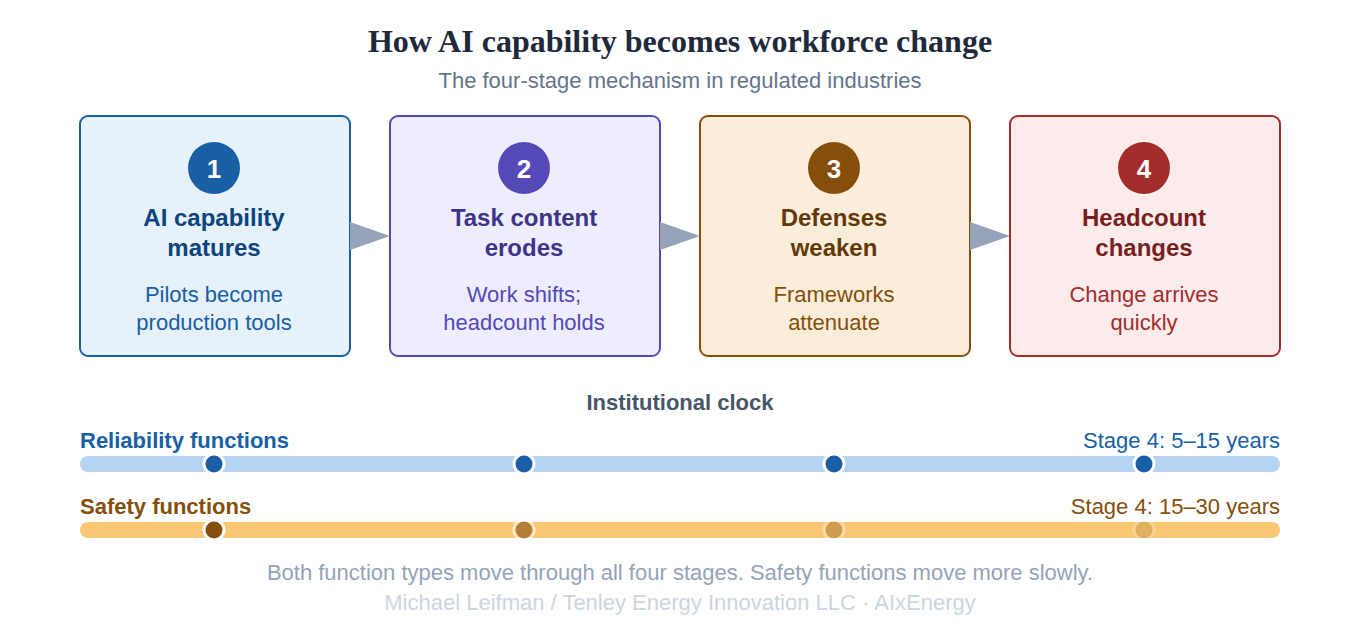
That pattern shows up in every regulated industry where human judgment has been codified into licensing requirements, union contracts, and staffing minimums. The change does not arrive as a single event. It arrives in stages. The first three can run for a decade without producing a single layoff. The fourth arrives fast.
In utilities, the sequence looks like this. First, an AI system moves from vendor demonstration into working production: drones flying autonomous inspection routes over substations, generative AI tools handling outage management in control rooms. Most of what is visible in US utility operations right now sits here. The technology is real and deployed. The workforce has not changed.
Second, the task content inside jobs starts to shift without the headcount moving. The power dispatcher is still a dispatcher, still licensed, still counted the same way in employment data. But what they actually do during a shift is different: less direct judgment, more supervising automated systems, more exception-handling. The institutional architecture around the role is intact. Nobody is renegotiating contracts yet.
Third, the institutional defenses start to lose their footing. Licensing requirements written against a description of the work that no longer matches reality. Staffing minimums built on workload assumptions the technology is eroding. Union contracts that codified ratios against a version of the job that has quietly changed. None of this collapses at once. The arguments for the old frameworks just become harder to make.
Fourth, the headcount changes, and it arrives quickly, relative to everything that came before.
Three other regulated industries show the same arc at different points. Freight rail is fighting over it in both directions: federal regulators required two-person crews in 2024, the railroads challenged it in court, a congressional nullification bill was introduced, and the autonomous locomotive technology keeps developing regardless. Aviation completed a stage-four transition in the 1980s with the flight engineer, and is now deep in the erosion phase on the copilot question: a 2025 European safety study found single-pilot operations couldn’t be demonstrated as safe and paused rulemaking, but the manufacturers haven’t stopped pushing. Maritime is building the international framework for autonomous vessels on a defined timeline, mandatory code targeting 2032.
None of these is the power sector. All of them show the same pattern: institutional defenses around safety-critical workforces don’t break under technological pressure. They erode. And then they give way.
For utilities, the question is where this happens first and how fast. Reliability functions (dispatch, load forecasting, customer service, compliance) are further along in the sequence than most workforce planning assumes. Safety functions (nuclear operations, protection relay coordination, energized switching) have more durable institutional defenses and longer timelines. Both are moving.
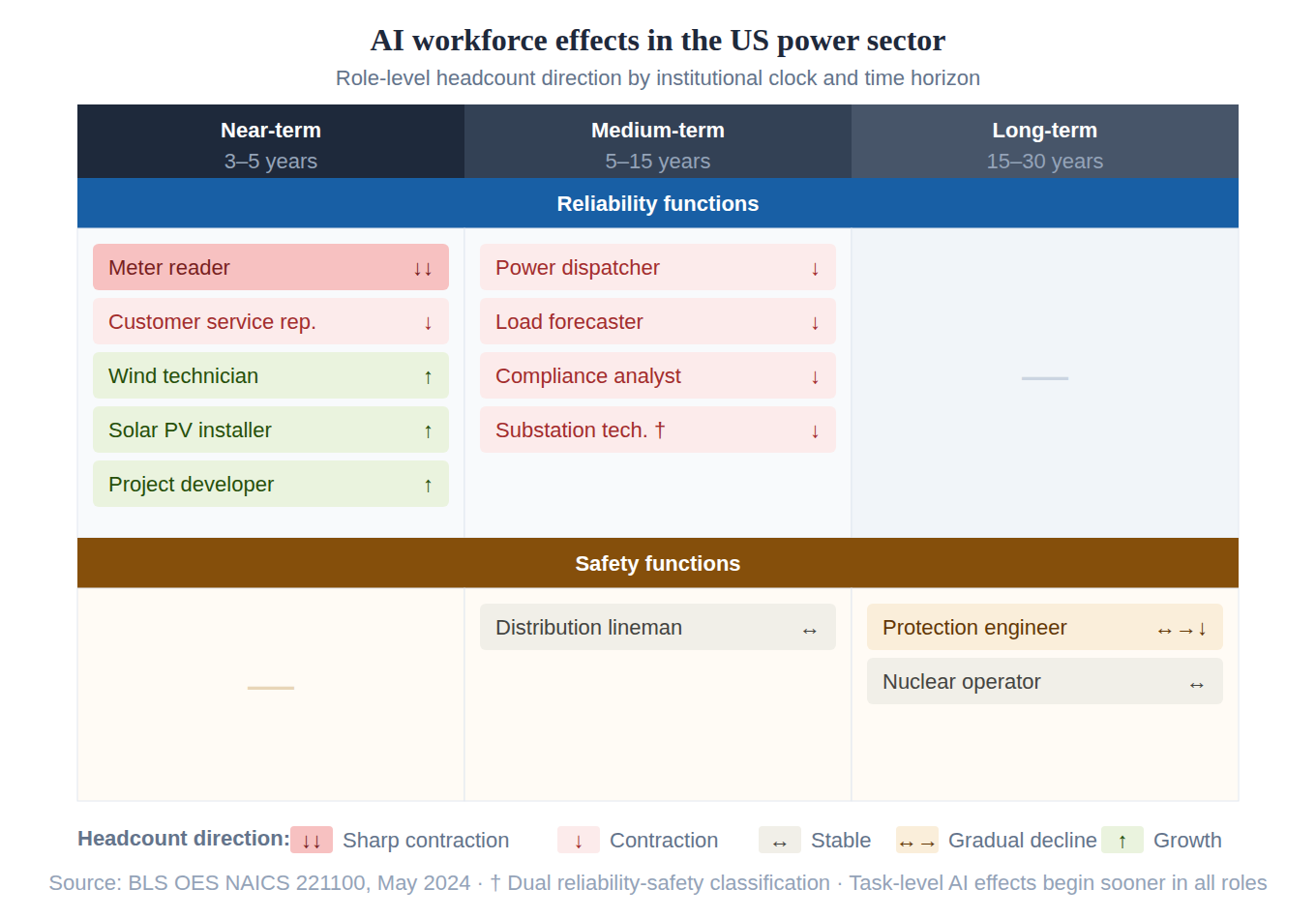
The full analysis, including the implications for utilities, regulators, investors, and workers, is in Part 2 of the series at AIxEnergy.